MICHAELINA WAUTIER. Malerin
What happens when an artist is overlooked for centuries — and suddenly takes center stage in one of the world’s most important museums?
The film accompanying the exhibition Michaelina Wautier. Painter at the Kunsthistorisches Museum Vienna follows precisely this moment of rediscovery.
Today, Michaelina Wautier is regarded as one of the great revelations of 17th-century art history. Highly esteemed in her own time, collected by major patrons such as Archduke Leopold Wilhelm of the House of Habsburg, and entrusted with demanding commissions, her name later almost entirely disappeared from art-historical memory. It was only through decades of research by art historian Katlijne van der Stighelen that Wautier’s work became visible again — a detective-like pursuit that began in the storage rooms of the Kunsthistorisches Museum and continues to this day.
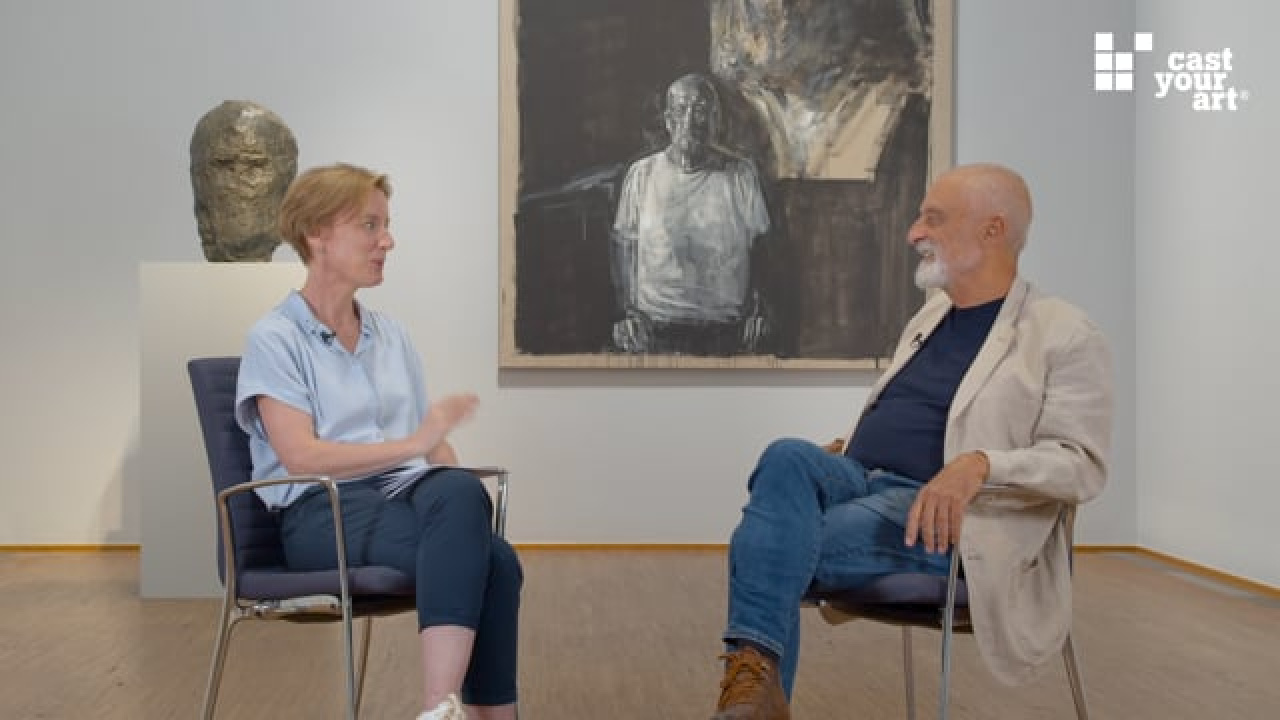
In the film, van der Stighelen and Kunsthistorisches Museum Director General Jonathan Fine discuss an artist whose work resists easy categorization. Wautier painted history paintings, religious and mythological scenes, portraits, floral still lifes, and scenes of everyday life — with a breadth and quality that were exceptional even by the standards of her male contemporaries. Particularly striking is her freedom in handling formats, models, and subjects: large-scale compositions, vividly lifelike figures, nude male bodies — all highly unconventional for a woman artist in the 17th century.
A key work of the exhibition is The Triumph of Bacchus. Following its restoration, the radical nature of the painting became unmistakably clear: an innovative composition, the physical presence of the figures, a striking directness of expression — and an artist who inserts herself into the painting as a bacchante while simultaneously meeting the gaze of the viewer. For Jonathan Fine, this moment carries a startling sense of contemporaneity: Wautier breaks the pictorial boundary, becoming both part of the scene and its commentator.
What gives her painting its enduring relevance is the immediacy of her figures. Whether playful boys, young saints, or mythological characters, they do not appear as distant historical types but as people with inner lives — marked by doubt, melancholy, and vitality. In works such as The Five Senses or her depictions of Saint Agnes and Saint Dorothy, Wautier’s extraordinary sensitivity to psychology, age, and lived experience becomes evident, as does her determination to rethink established pictorial conventions.
The film makes clear that Wautier’s disappearance from art history was no coincidence. Her versatility, technical brilliance, and thematic audacity long contradicted prevailing expectations of what a woman artist could achieve. When her name was lost from attributions, her place in art history was effectively erased as well.
The exhibition and the film therefore function not only as a tribute to an outstanding painter, but also as a call for new perspectives on historical collections. For Jonathan Fine, this is precisely where the contemporary relevance of old art resides: when we ask different questions, these works begin to speak again — clearly, directly, and with surprising urgency.
https://www.khm.at/Das könnte Sie auch interessieren
Public Space - Consensus or Conflict?
19. October 0000
WAS SIE SCHON IMMER ÜBER DÜRER WISSEN WOLLTEN. Teil 4. Von Inspirationen, Vorbildern und Nachahmern
26. July 2021
MICHAEL HOROWITZ. About Stars and Nearness in Photography
24. March 2020
Manfred Wakolbinger - The Ephemeral and the Eternal
16. May 2012
Seurat, Signac, Van Gogh - Ways of Pointillism
7. October 2016
COLLECTED #4. Bilder über Bilder
3. March 2014
HELEN & HARD. Wiens Städtebau und zeitgenössische Architektur
8. May 2015