

Aivazovsky - A Russian fairytale
Aivazovsky is regarded as the master of seascapes. In his lifetime he dedicated himself to this motif as a metaphor for life, of desire as well as the struggle between nature and culture.
For the first time, the Bank Austria Kunstforum shows a retrospective of the artist outside of Russia and the Ukraine. There are fifty representative paintings on display, among them main works from the Aivazovsky Museum in Feodosia and the Russian Museum in Saint Petersburg that have never been shown abroad.
As legend has it, he died in his studio with a brush in his hand, 111 years ago. In his exceptionally long life he actually left only this one painting unfinished, out of the estimated 6000 he painted. In his lifetime his works were already marvelled at, admired, venerated – and purchased.
He is regarded as the most successful Russian Romanticist of the 19th century. However, in European art history his name seems almost forgotten. We are referring to Ivan Konstantinovitch Aivazovsky, a painter who was capable like no other to bring light, air and water onto the canvas in a most realistic manner.
Aivazovsky was born 1817 in Feodosia, a small seaport on the Black Sea as a child of Armenian refugees. As a small boy at first he displayed his artistic talent on the walls of his neighbourhood, making do with the charcoal of a samovar. After successful studies in Saint Petersburg he went on study trips throughout Europe. From the outset, his oeuvre was met with enthusiasm. On of his admirers was the English Romantic painter J.M.W. Turner. Turner called his views of Naples the work of a genius.
Just like Turner, Aivazovsky did not paint outdoors but after sketches he made in his studio. These sketches often did not consist of more than a few outlines; he recalled most of the content from his memory. Considering this fact, the accuracy of his city views of Constantinople, Venice or Naples is even more astounding. Not only did he depict architecture in a remarkably realistic way but also images of moonlit landscapes or sunrises, some of which he had not even witnessed.
Reportedly Aivazovsky had an encounter with a contemporary at the Biarritz coast. It had been a foggy day and Aivazovsky inquired about the course of the sun. On the following day, Aivazovsky painted the surf of Biarritz with a few strokes, in three different light moods. This pragmatism must have had an almost provocative effect on many a romanticist contemporary of his time. In his case, the suggestion of a personal sensory perception emerges virtually as a readily available recipe.
However, the impact of his paintings is not due merely to his imagination, but essentially originates from the pictorial itself. His rapid working methods and the very thin layers of paint allowed for smooth shadings, creating an almost aquatic transparency and an atmosphere illuminated by a special light. Their visual magnetism and luminosity appeared so uncanny to the visitors of the Paris Salon that they inspected the reverse sides of the paintings for possible light sources.
Ayvazovsky was an exceptional personality of his time, not only in the artistic sense. He used his wealth for charitable purposes and his creative power for modernizing efforts in his hometown Feodosia. Today he is an integral part of Russian history and has his place in all schoolbooks. (ko/ca)
https://www.kunstforumwien.at/Das könnte Sie auch interessieren
CINO ZUCCHI ARCHITETTI. Wiens Städtebau und zeitgenössische Architektur
20. November 2015
Robert Pan - Work in Layers
24. July 2013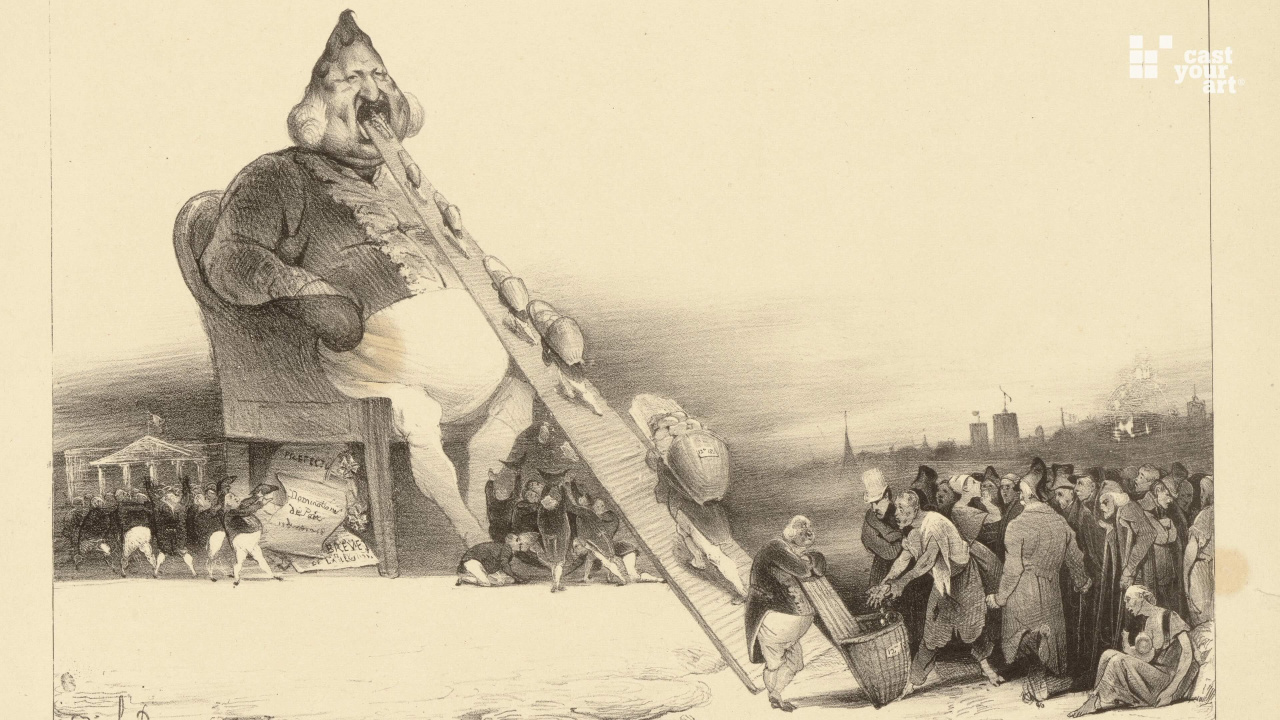
HONORÉ DAUMIER. Mirror of Society
16. March 2026
Francisca Benitez - Ephemeral City
18. March 2009
Egon Schiele - The Nude
9. March 2017
FRANCESCA WOODMAN. The Body as Poetry, the Image as Presence
14. May 2025
ALBERTINA TOURS & TALKS. A tour through Albertinas Wilhelm Leibl exhibiton by chief-curator Christof Metzger
7. July 2020